
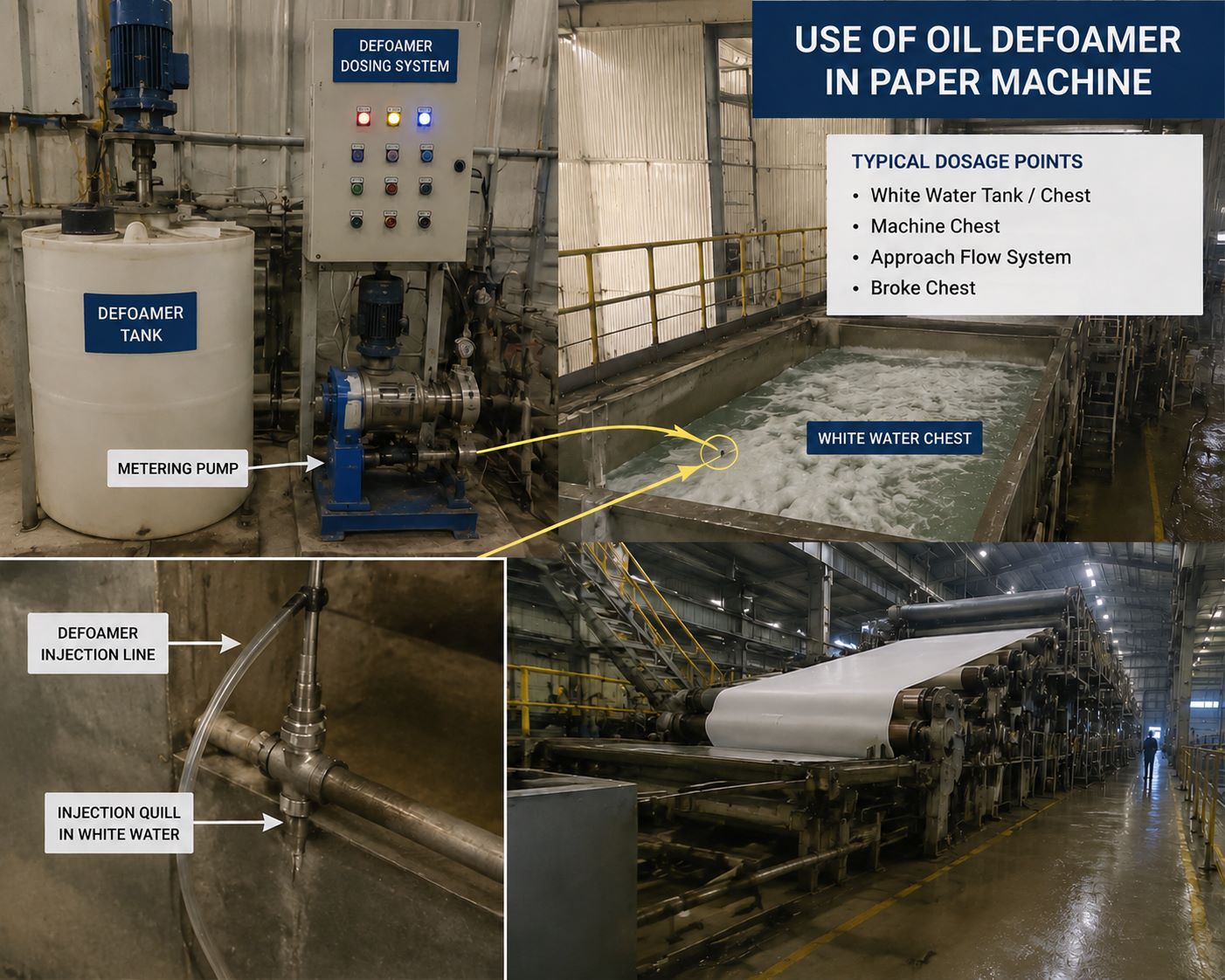
In modern papermaking, production speed and product quality are closely connected with process stability. One of the key challenges in high-speed paper machines is unwanted foam formation. Foam may look harmless, but in industrial systems it can seriously affect drainage, formation, and overall efficiency. This is where a Paper Machine Defoamer plays a critical role—especially oil-based formulations that are widely used for stable and long-lasting foam control.
An oil-based defoamer for paper industry is designed to break and prevent foam formation in pulp processing, wet-end operations, and coating systems. It works by reducing surface tension and destabilizing foam bubbles so they collapse quickly, helping the paper machine run smoothly without interruptions.
Why Foam is a Problem in Paper Machines
During papermaking, air enters the system at multiple stages—pulp mixing, pumping, chemical dosing, and high-speed circulation. This trapped air forms foam, which leads to:
- Poor drainage on wire section
- Uneven sheet formation
- Reduced paper strength
- Increased energy consumption
- Machine instability and breakages
To manage this, mills rely on effective foam control solutions like Paper Machine Deaeration systems and chemical defoamers. While mechanical deaeration removes bulk air, chemical defoamers handle microfoam that is difficult to eliminate physically.
What is an Oil-Based Defoamer?
An oil-based defoamer is a formulation typically built using:
- Mineral oils or vegetable oils
- Hydrophobic particles (for foam film disruption)
- Emulsifiers for controlled dispersion
This combination allows it to spread quickly on foam surfaces and break bubbles efficiently.
Unlike fast-dispersing surfactants, oil-based systems work by creating localized instability in foam films, leading to rapid collapse.
In paper mills, this makes them especially useful in wet-end processes where foam is persistent and continuously generated.
Key Functions of Paper Machine Defoamer
A high-performance Paper Machine Defoamer is not just about foam removal. It supports multiple process functions:
1. Foam Suppression
Prevents formation of stable foam in pulp suspension and white water systems.
2. Air Release Support
Improves Paper Machine Deaeration by helping trapped air escape faster from slurry systems.
3. Process Stability
Ensures smooth flow in pumps, screens, and headboxes.
4. Better Sheet Formation
Reduces air pockets that cause weak spots in paper structure.
5. Chemical Efficiency
Improves performance of sizing agents, fillers, and retention chemicals by eliminating foam interference.
Advantages of Oil-Based Defoamer in Paper Industry
Oil-based systems are still widely preferred in many paper mills due to their balanced performance.
Strong and Long-Lasting Action
They provide sustained foam control even in high-turbulence conditions.
Cost-Effective Performance
Low dosage is often sufficient for effective control, making it economical.
Compatibility with Wet-End Chemistry
Works well with most pulp additives without disturbing system balance.
Effective in High Temperature Systems
Performs consistently in warm and high-speed paper machine environments.
Suitable for Continuous Operations
Ideal for mills running 24/7 production cycles.
Where Oil-Based Defoamers Are Used
The application of oil defoamer systems is not limited to one section of the paper process. They are widely used across:
Pulping Section
Controls foam during chemical pulping and mechanical pulping processes.
Stock Preparation
Prevents air entrapment during mixing, refining, and blending.
Headbox System
Ensures uniform fiber distribution without foam interference.
White Water Circulation
Maintains clean recirculation loops and improves drainage efficiency.
Coating and Surface Treatment
Supports smooth coating application without foam defects.
Oil-Based vs Other Defoamer Types
Different types of defoamers are used depending on process needs:
Oil-Based Defoamers
- Best for persistent foam
- Strong in high-turbulence systems
- Widely used in paper machines
Silicon-Based Defoamers
- Extremely fast foam breaking
- Effective in low dosage
- Used in coating and specialty applications
Water-Based Defoamers
- Environment-friendly formulation
- Easier dispersion in aqueous systems
- Preferred in sensitive chemical processes
Each type has its role, but oil-based systems remain a backbone solution in Paper Machine Defoamer applications due to reliability and durability.
Role in Paper Machine Deaeration
Foam control is closely linked with Paper Machine Deaeration. While deaeration focuses on removing dissolved and entrapped air, defoamers accelerate this process by destabilizing foam layers on the surface.
When both systems work together:
- Air pockets reduce significantly
- Sheet density improves
- Machine speed increases
- Breakdowns decrease
This synergy directly improves production efficiency and paper quality consistency.
Common Industrial Benefits
When properly applied, oil-based defoamers help paper mills achieve:
- Higher production speed
- Reduced machine downtime
- Improved surface smoothness
- Better drainage performance
- Lower energy consumption
These improvements translate into better operational efficiency and reduced cost per ton of paper produced.
What Changes in Production
An oil-based Paper Machine Defoamer is an essential part of modern papermaking chemistry. It supports foam control, enhances deaeration efficiency, and stabilizes the entire wet-end process. When integrated correctly, it ensures smooth production flow, better paper quality, and improved machine performance.
In highly demanding paper systems where foam control is critical, selecting the right anti foam chemical or anti foaming agent for oil becomes a key operational decision. Oil-based formulations continue to remain a dependable choice due to their stability and broad compatibility in industrial environments.
For consistent performance and process reliability, industries often rely on specialized solutions from a trusted defoamer manufacturer Balaji Chem Solutions. Contact Balaji Chem Solutions today to get the right oil-based defoamer and paper machine solutions tailored for improved efficiency, stable operations, and better production quality.
Frequently Asked Questions
Oil-based defoamer is a chemical formulation using oils that quickly breaks foam and prevents bubble formation in industrial liquid systems.
A defoamer is used to control and eliminate unwanted foam in industrial processes, improving efficiency, stability, and product quality.
In oil and gas, defoamer reduces foam in drilling fluids and production systems, ensuring smooth flow and operational efficiency.
Antifoaming agents in oil are substances that reduce surface tension, preventing foam formation and ensuring smooth processing operations.