
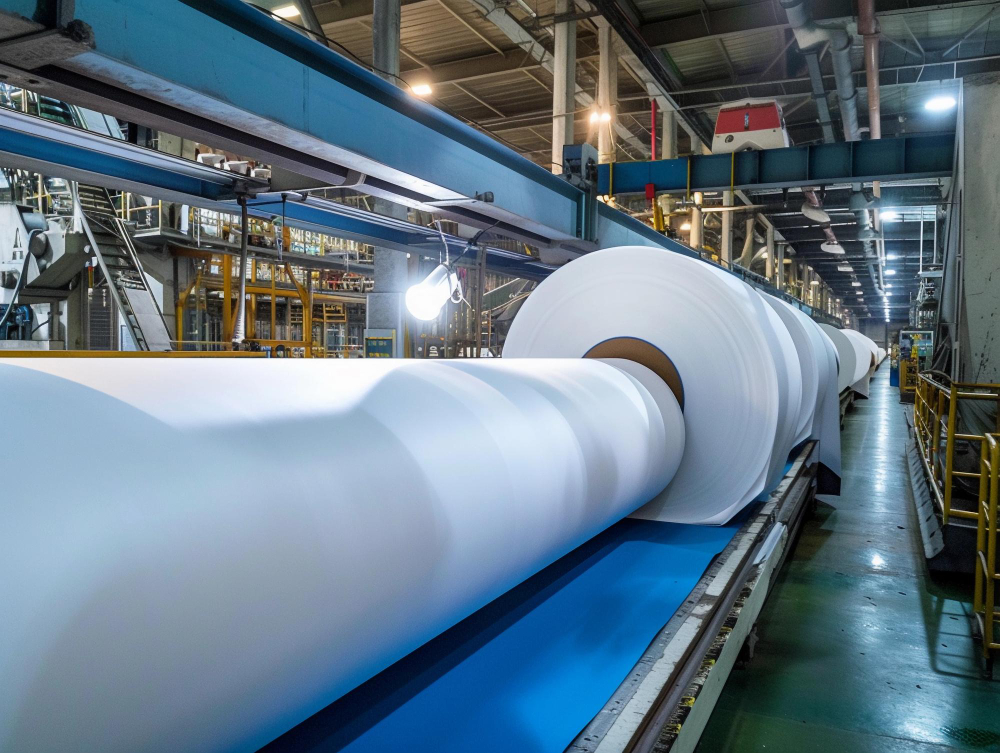
In modern papermaking, linting and dusting are critical issues, especially on high-speed machines. These problems not only affect machine cleanliness but also reduce print quality, increase downtime, and impact overall production efficiency. When fibers, fines, or fillers are not properly bonded within the sheet, they tend to detach during printing, converting, or reel handling. This leads to lint (fiber fragments) and dust (fine particles) accumulating on machine parts.
To control this, mills rely heavily on Cationic Starch, a key additive that strengthens the internal structure of paper and improves surface integrity.
Linting and Dusting with Cationic Starch
Linting refers to the release of fibers from the paper surface, while dusting involves the shedding of fine particles like fillers or broken fiber fragments. These issues become more severe as machine speed increases.
On high-speed machines:
- Web tension is higher
- Mechanical stress increases
- Weak fiber bonding is exposed faster
- Surface picking becomes more aggressive
This means even small bonding issues inside the sheet can quickly turn into major operational problems.
Why Cationic Starch is Important in Paper Industry
Cationic Starch carries a positive charge, while paper fibers and fillers are naturally negatively charged. This charge difference allows the starch to attach strongly to these particles.
Because of this, it plays a dual role:
- Improves internal strength of the sheet
- Enhances retention of fines and fillers
The result is a more stable and well-bonded paper structure that resists fiber and particle release.
How Cationic Starch Prevents Linting and Dusting
The effectiveness of Cationic Starch comes from how it works inside the paper matrix.
1. Stronger Fiber Bonding
Cationic Starch acts like a binding agent between fibers. It increases fiber-to-fiber bonding, which directly improves dry strength.
- Fibers stay tightly connected
- Surface fibers do not lift easily
- Sheet resists mechanical stress
This reduces the chances of fibers breaking away during printing or converting.
2. Better Retention of Fines and Fillers
Fines and fillers are the main source of dust if not properly retained.
Cationic Starch helps by:
- Attaching fines to fiber surfaces
- Holding filler particles within the sheet
- Reducing material loss in white water
This creates a cleaner and more uniform sheet, minimizing loose particles.
3. Improved Sheet Consolidation
When fibers, fines, and fillers are properly bonded, the sheet becomes more compact and stable.
This leads to:
- Reduced weak spots in the sheet
- Better formation consistency
- Lower surface friability
A well-consolidated sheet is less likely to generate lint or dust under stress.
4. Enhanced Surface Strength
Surface weakness is a direct cause of linting in printing processes.
With proper use of Cationic Starch:
- Surface fibers are more strongly anchored
- Picking resistance improves
- Print performance becomes more stable
This is especially important for printing and writing grades.
Why High-Speed Machines Need Cationic Starch More
High-speed machines amplify every weakness in paper.
At higher speeds:
- Fiber detachment happens faster
- Dust builds up quickly on rollers and blankets
- Machine stoppages increase due to cleaning needs
Cationic Starch helps control these issues by strengthening the sheet before it reaches these high-stress zones.
In simple terms, it prepares the paper to handle speed without breaking down.
Key Benefits of Using Cationic Starch
From a practical mill perspective, using Cationic Starch provides multiple advantages:
- Reduces linting and dusting problems
- Improves machine runnability
- Enhances print quality
- Minimizes downtime and cleaning frequency
- Supports higher production speeds
- Improves overall paper strength and formation
These benefits make it a standard and essential additive in most paper mills.
Important Considerations
While Cationic Starch is highly effective, results depend on proper application.
Factors to control include:
- Correct dosage level
- Proper addition point (wet-end or size press)
- Charge balance in the system
- Interaction with other chemicals
If not optimized, performance may not be fully achieved.
What Drives Better Machine Results
Linting and dusting are not just surface problems—they are signs of weak bonding inside the paper. The stronger and more uniform the sheet structure, the lower the chances of fiber and particle release.
Cationic Starch plays a critical role in solving this by improving bonding, retention, and overall sheet integrity.
For paper mills running high-speed machines, it is not just a chemical additive—it is a performance tool that ensures cleaner operation, better quality, and more efficient production.